








Select a language
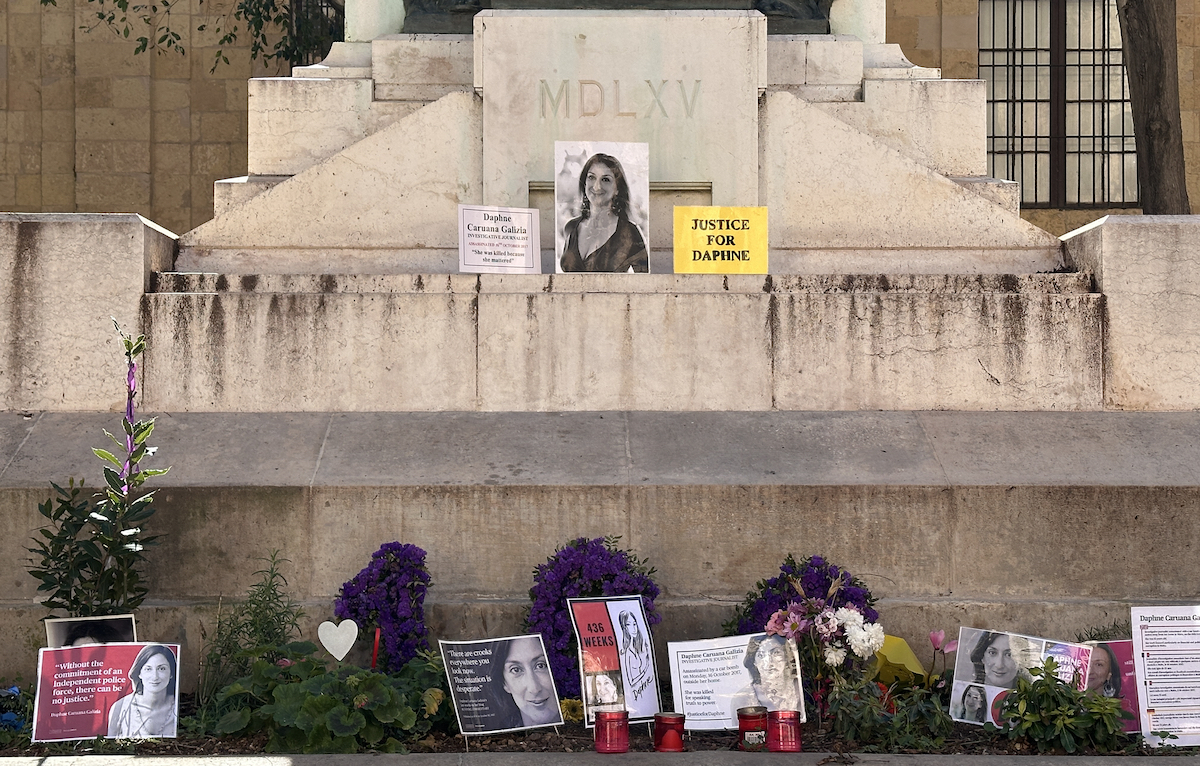
On 2 September, at around 7.30 pm, after 55 days and more than 100 witness testimonies – the longest murder trial in Maltese legal history – a jury acquitted Yorgen Fenech, heir to one of Malta’s most powerful business families, of charges of aiding and abetting and criminal association in connection with the murder of journalist Daphne Caruana Galizia.
The verdict, delivered after eight hours of deliberation, came as a shock to many Maltese. For the Times of Malta, the island’s leading daily newspaper, Bertrand Borg described the defendant’s family shouting with joy in the courtroom, whilst the victim’s relatives were left in tears. Outside the court, a crowd chanted “scum”, “mafia” and “murderer”.
“In many ways, Malta itself was on trial”, says Herman Grech, the Times of Malta’s editor-in-chief. A journalist for over thirty years, he has followed the proceedings from day one and says he has never seen such widespread public interest in a trial. Many Maltese, he says, believe that the early timing of recent elections, held in June, was not unrelated to this highly sensitive trial. The event turned into a media sensation, beginning with the jury selection. “For 55 days, the country was gripped by what was happening in that courtroom.”
Three accounts and no certainties
The case rested almost entirely on the testimony of Melvin Theuma, a taxi driver and middleman who was granted a presidential pardon in 2019. He claimed that Fenech had given him the order and the money to recruit the killers. Fenech, for his part, admitted that he had known in advance that the murder was being planned and that he had paid money to Theuma, but maintained that he had sought to stop the murder, not to fund it.
He named his former friend Keith Schembri, chief of staff to Joseph Muscat, the prime minister at the time of the events, as the real instigator. Called to give evidence, Schembri denied everything and turned the accusation back on Fenech, claiming that the latter had virtually confessed the crime to him.
“All roads lead to Keith Schembri”, argued the defence lawyer. But the investigation was never able to prove this. Schembri’s mobile phone and computer were never found, his government office was not searched until more than a week after his arrest, and several leaks marred the investigation from the outset.
In the absence of evidence beyond reasonable doubt, Judge Edwina Grima reminded the jury that the burden of proof lay entirely with the prosecution. The jurors returned a verdict of acquittal by eight votes to one. Who cast the dissenting vote remains unclear.
Yorgen Fenech: a reflection of the system
Herman Grech says that Yorgen Fenech had kept “a relatively low profile” before the affair, despite being the heir to a family empire built up in the 1970s from a simple furniture shop. The Tumas Group is now a major player in Maltese property, hospitality and gambling. Fenech himself is closely associated with Electrogas, the consortium selected in 2013 to supply the island with electricity, personally holding a 10% stake in it.
The trial and the publication of thousands of messages revealed the extent of his access to the highest echelons of government. “Fenech eventually came to represent something much bigger than an individual wealthy businessman”, says Herman Grech. “He became emblematic of the questions Malta has been confronting for years about the relationship between big business, political power and the institutions that are supposed to regulate both.”
It was while investigating the Electrogas contract and a Dubai-based offshore company, 17 Black, that Daphne Caruana Galizia crossed paths with Yorgen Fenech. As early as February 2017, she established that 17 Black was being used to channel large sums of money linked to high-profile political figures, including government minister Konrad Mizzi and Schembri himself. The link was confirmed some two years later by an investigation by Reuters and the Times of Malta. OCCRP published a more detailed version of that report as part of the Daphne Project.
Access: the master key to politics and business
To understand this case, one must understand Malta. It is the smallest member state of the European Union, and one of the most densely populated countries in the world. On this island, as Herman Grech puts it, “everyone seems to know everybody else”. There has always been a closeness between politics, business and social life. But, says Grech, that situation has become institutionalised – indeed, taken to extremes – over the last decade, against the backdrop of a spectacular economic boom sparked by the programme of Joseph Muscat.
This former prime minister (in office 2013-20) sought to turn the island into a “Singapore of the Mediterranean”. Relaxation of planning regulations brought about rampant building development, a dizzying rise in property prices and, above all, an explosion in the value of access to decision-makers.
Added to this is a quasi-tribal two-party political system – Labour and the Nationalists have shared power since independence in 1960 – in which political allegiance is often passed down within families. A consequence of this, says Herman Grech, is that allegations of wrongdoing “are often viewed through a partisan lens: is this an attack on my side or your side?” Such a context complicates institutional accountability. “I’m not saying that every relationship between business and politics is corrupt“, tempers Grech. ”In a country this small, proximity is unavoidable. The crucial question is whether proximity becomes access, access becomes influence, and influence becomes preferential treatment.”
Investigations by the Italian investigative outlet IrpiMedia document these close connections. Among the former associates of the Agius brothers – the “Tal-Maksar” gang members who were sentenced in 2025 to life imprisonment for the bombing that killed Daphne Caruana Galizia – is a cousin of Keith Schembri, who is currently facing charges of fraud and money laundering. The same names crop up time and again, in one court case after another.
Political allegiances are reflected even in the media. “Malta is the only EU country where major political parties directly own and operate extensive 24/7 broadcasting infrastructure”, points out Rebecca Bonello Ghio, a Maltese policy officer at the European Federation of Journalists (EFJ) in Brussels. “The Labour Party operates ONE and the Nationalist Party operates NET. Appointments to the Public Broadcasting Services board, which are the direct responsibility of the minister in charge, are not transparent.” Independent newsrooms, for their part, are subject to the influence of advertisers.
The anger of 2019 has given way to fatalism
In 2017, the initial public reaction to the murder of Daphne Caruana Galizia was a somewhat muted shock. Malta had already experienced car-bomb attacks, usually linked to organised crime. Yet “this was different”, recalls Herman Grech. “A journalist had been assassinated because of her work.”
Everything changed in late 2019, when evidence implicating figures close to the government began to emerge. Thousands of ordinary Maltese took to the streets. Labour’s Prime Minister Joseph Muscat, who had been one of the most popular leaders in the country’s recent history, was forced to resign.
Fenech’s acquittal reopens this wound, but in a different way. “In 2019, there was anger, accompanied by a sense that the truth was finally emerging”, says Herman Grech. “This time, alongside the anger, I sense resignation and despair.” He recounts having to comfort journalists in his newsroom who were in tears following the verdict, yet being unable to console them with any hope: “For them, it felt as though we had suddenly been transported back to 2017. The most fundamental question was left unanswered: who ordered Daphne’s murder?”
The Times of Malta’s editor-in-chief is careful, however, not to question the verdict itself. “As a journalist and editor, I have to respect the verdict. The jurors were not convinced of Fenech's guilt beyond reasonable doubt, and that is how the justice system works.”
But respecting a verdict does not make the fundamental questions go away, says Herman Grech: “Was the investigation good enough? Did the defence simply do a better job of creating reasonable doubt than the prosecution did of eliminating it? Should we ignore claims of potential jury tampering? And if Fenech was not involved in conspiracy and complicity to murder, who was? Who did the five men jailed for the crime get their orders from?”
‘The jury’s verdict cannot silence everyone’
In an opinion piece in the Times of Malta, civil-rights campaigner Alessandra Dee Crespo takes this same concern a step further. She fears that Fenech’s acquittal will be exploited to rehabilitate an entire political class. This despite the fact that a public commission set up in 2019 by the Maltese parliament concluded in 2021 that the state bore some responsibility for the murder, having allowed a “climate of impunity” to develop from the highest levels of government. That finding has never been overturned.
Alessandra Dee Crespo is calling for an independent review of the police investigation itself. She questions the leniency reportedly shown throughout the proceedings towards certain political and business figures. “'The jury has spoken' cannot become a command that everyone else must stop speaking”, she writes, warning that the danger now lies in collective resignation. The European Commission, in its 2024 report on the rule of law, pointed out once again the lack of concrete measures to protect journalism in Malta.
In a statement, the victim's family speaks of “justice denied”. They stress that the individuals who enabled or protected her killers have still not been held to account. “I think that there was a campaign that the government facilitated to dehumanize my mother to no end“, says Daphne Caruana Galizia’s son Matthew. ”To make people comfortable with allowing the person who killed her, who was complicit in her murder, to walk free.”
After the trial, what next?
The prosecution has announced its intention to appeal. However, Maltese law sets a high threshold for any appeal. It will not be enough simply to argue that the jury erred on the facts: it must be demonstrated that there was a serious procedural irregularity or a clear error in the application of the law. Legal experts consulted by Herman Grech are sceptical about the chances of securing a retrial. The EFJ’s Rebecca Bonello Ghio agrees: “What is certain is that it will take a long time, as the Maltese courts are very slow and face significant structural, procedural, and administrative challenges.”
The case has become even more complicated in recent days. Four members of the jury and the husband of one of them have been arrested, a development that adds fuel to the suspicions of manipulation.
Bonello Ghio is not optimistic: “During the trial we heard about the immense proximity that people with power and money in Malta have to each other – and how they abuse their access to power. I feel that the situation is bleak, that change is [difficult] in such a polarised and corrupt country. Of course, it is encouraging to have seen so many people protest in Malta, Brussels, Paris, London, Berlin, Dusseldorf, and Dublin, and I'm trying to cling to that hope.”
Faced with this reality, Herman Grech describes “an air of hopelessness and helplessness”. He says that many are already comparing the case to that of OJ Simpson in the United States: an extraordinary trial that captivated the country, and a sensational acquittal. And now old wounds that have been reopened – which, this time, may never heal.
For Malta, the question raised by this verdict goes beyond the fate of a single man. On this island where everyone knows one another, can the proximity between money, power and justice ever cease to be part of the system?
A press held hostage by polarisation
According to Rebecca Bonello Ghio, the judgement of 2 September “confirms that in Malta, you can order the murder of a journalist and get away with it, and that has clear and serious ramifications for the safety of journalists”.
She notes, however, that the trial has had a positive effect on the island’s media landscape. “Newsrooms are seeing how important their role is. I believe I've seen an improvement of the profession and the sector in the last couple of months as newsrooms take seriously their duty to report the case, and the reaction to it, to the public.”
Yet on the overall state of press freedom in Malta, Bonello Ghio adds an important caveat. “There is a lack of trust in journalism. People receive different information in their bubbles. Malta is a very polarised country, and press freedom struggles as a result of that – particularly now, when there's a group in society that will view journalists and those supporting Daphne's family as 'the enemy'.”
🤝 This article was produced within the PULSE collaborative project. OBCT (Italy) contributed to it.
🗣️ Have a question, comment or suggestion? Share it with us through the PULSE reader form – we read and reply to every message. Be part of Europe’s conversation. Your experiences and ideas can inspire the next stories we tell. Join the PULSE readers’ community by filling in this short form.
Do you like our work?
Help multilingual European journalism to thrive, without ads or paywalls. Your one-off or regular support will keep our newsroom independent. Thank you!