












Select a language
We are not even halfway 2022 and I can already say that the year is neither what I thought nor what I hoped. Sure, COVID-19 has indeed not been the “great disrupter;” in fact, most governments have ended almost all COVID-19 measures and we have largely wished ourselves into a post-COVID-19 era. We probably would have done that even without the Russian (re-)invasion of Ukraine but it definitely helped change the mindset and priorities of most Europeans. And while it is also true that Illiberalism has replaced Brexit as the prime focus of the EU, this is more external than internal, i.e. about Vladimir Putin’s Russia rather than Viktor Orbán’s Hungary, let alone Jarosław Kaczyński ’s Poland.
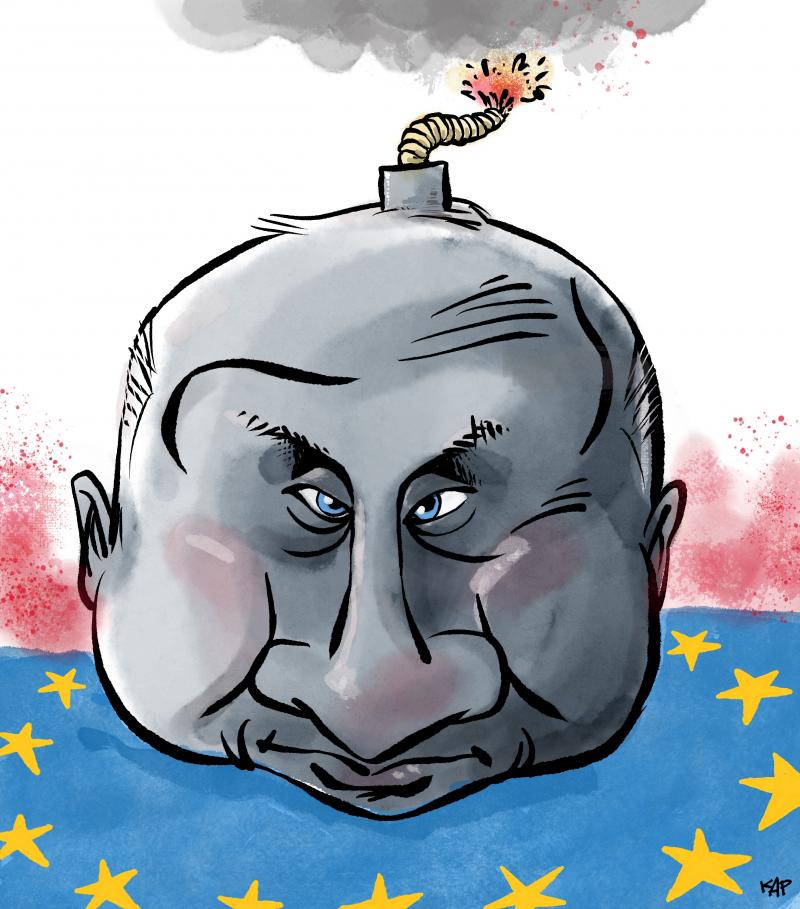
The Russian (re-)invasion of Ukraine is the fifth political crisis of the 21st century – after 9/11, the Great Recession, the so-called refugee crisis, and the COVID-19 pandemic. That is one crisis for roughly every five years! The Ukraine War has at the very least postponed the political reckoning of the pandemic. It will likely be the most significant political crisis of all, possibly bare 9/11. It has already affected some of the key national elections in Europe, ironically helping both Viktor Orbán in Hungary and Emmanuel Macron in France. However, while the former won bigger at home, albeit in free but unfair elections, it is the latter who will come out the main winner at the European level.
Orbán surprised friends and foes with his massive electoral victory. Making the most of his monopoly on the state media – the opposition got a mere five minutes of airtime on state media – he turned the Ukraine War into an asset rather than a liability, presenting himself as the reliable and stable leader who would keep Hungary out of the war and the energy prices low. But while his “neutral” position played well at home, where both Fidesz-controlled private and public media continue to have a strong pro-Russian coverage, it is increasingly isolating him outside of abroad. After losing Czech leader Andrej Babiš in last year’s elections, and Austrian Chancellor Sebastian Kurz in a political scandal, Orbán will soon lose another ally in Prime Minister Janez Janša, who lost last month’s Slovenian elections.
Most importantly, the Ukraine War has created an increasingly serious rift in the Budapest-Warsaw alliance, the core of the illiberal front within the EU. While many commentators like to emphasize the support for Putin from the far right – which is not as strong as that from the far left anyway – the war is not really a division between “the mainstream” and “populists”.
In fact, within the European Council, both the strongest opponents and supporters of Putin are (radical right) populists, Poland’s Law and Justice (PiS) and Hungary’s Fidesz, respectively. Over the past months, Orbán has been missing from various regional pro-Ukraine events, as the Visegrad 4 is rapidly turning into the Visegrad 3, after Czechia, Poland, and Slovakia refused to attend a V4 meeting of defense ministers in protest of Hungary’s pro-Russian stand.
As foreign policy takes priority over domestic policy concerns, there is a risk that the new litmus test for Europe will be an anti-Russia position rather than respect for liberal democratic institutions and values
Macron made the most of the Ukraine War to present himself as a world leader, having more meetings with Putin than his American, British, or German counterparts, but was forced into domestic politics to defeat Marine Le Pen in the second round of the presidential elections. Freshly re-elected, and serving as chairman of the Council of the EU, he was expected to use Europe Day to outline his ambitions for a liberal democratic Europe in Brussels – ironically, on the same day as Putin used the Victory Day to outline his vision for an illiberal Europe. With the Germans being confronted with decades of economic dependence and political appeasing of Russia, Europe is looking to France to take the lead and Macron is happy to do so, if only because he still has a crucial parliamentary election in June, which can make or break his presidency – if he is forced into cohabitation, i.e. co-governing with a prime minister from another party, his second term will have to be much less ambitious and could end up in gridlock.
Whatever the outcome of the French parliamentary elections, the EU and its member states have important decisions to make. In the short term, defense and energy policy will be high on the agenda, and both will have to undergo fundamental changes after decades of complacency and neglect. At the same time, EU (and NATO) enlargement is back on the agenda, notably of Ukraine and the Western Balkans. All these issues will be promoted by using the familiar narrative of protecting liberal democratic Europe against illiberal Russia. The big question is, how will this external struggle against illiberalism affect the domestic one?
So far, the camps have been far from ideologically homogeneous. Just as the US included illiberal India in its “Summit for Democracy”, the EU increasingly celebrates illiberal Poland for its staunch anti-Russia and pro-Ukraine position, including its generous reception of more than three million (!) Ukrainian refugees. As foreign policy takes priority over domestic policy concerns, there is a risk that the new litmus test for Europe will be an anti-Russia position rather than respect for liberal democratic institutions and values. This might be bad news for Hungary, but also for the EU. Because unlike NATO, the EU is not primarily a defense alliance, it is a “Community of Values”, more specifically, liberal democratic values.

Check out Cas Mudde’s podcast show Radikaal. It focuses on the radical aspects of music, politics & sports. Each episode includes a conversation with one guest about a specific topic.
Do you like our work?
Help multilingual European journalism to thrive, without ads or paywalls. Your one-off or regular support will keep our newsroom independent. Thank you!


